

Why Getting “30 Years’ Experience” Right Actually Matters
30 years experience is one of the most commonly miswritten phrases in professional documents — and the fix is simpler than you think.
Quick answer: Which form is correct?
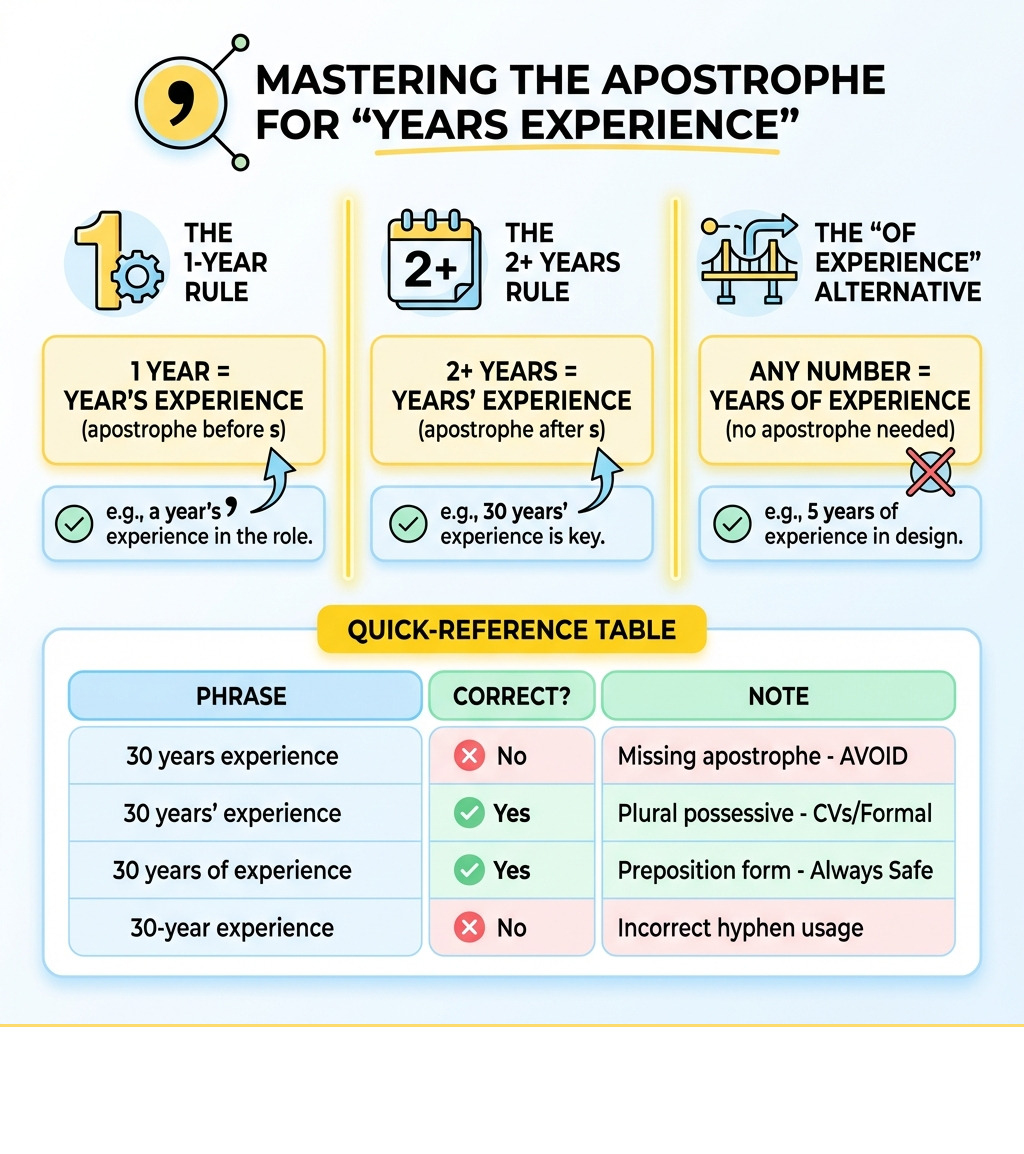
| Phrase | Correct? | When to Use It |
|---|---|---|
| 30 years experience | No | Missing apostrophe — avoid this |
| 30 years’ experience | Yes | Plural possessive — use in CVs and formal writing |
| 30 years of experience | Yes | Preposition form — always grammatically safe |
| 30-year experience | No | Incorrect hyphen usage in this context |
Whether you’re writing a resume, a business bio, or professional marketing copy, this small punctuation detail signals whether you know your craft — or don’t. Recruiters spend less than 10 seconds scanning a resume before making a decision. A grammar slip right at the top can cost you that first impression.
The rule itself is straightforward once you see it. The apostrophe after “years” works the same way as “a week’s work” or “a month’s holiday” — the experience belongs to those years. When in doubt, swap in “of experience” and the meaning stays identical with zero ambiguity.
I’m Michael Catanzaro of Catanzaro & Sons, a family painting business built on craftsmanship and trust — and one that knows what 30 years’ experience actually looks like in practice, having grown from our founder Hank Catanzaro Jr.’s first painting projects in the 1980s into the full residential and commercial operation we run today. That real-world perspective shapes everything we share here.
30 years experience vocab to learn:
The Grammar Police: Is it “30 Years Experience” or “30 Years’ Experience”?

When we talk about our 30 years experience at Catanzaro & Sons, we aren’t just throwing numbers around; we’re using a phrase that carries the weight of thousands of hours on ladders and scaffolding across Rhode Island. But from a purely grammatical standpoint, the “Grammar Police” often have a field day with this one.
The core of the debate is whether the “experience” actually belongs to the “years.” In her famous book Eats, Shoots & Leaves, Lynne Truss bemoans the loss of the apostrophe in modern culture. She argues that time expressions are essentially possessive. If you have “one day’s pay,” the pay belongs to that day. Therefore, if you have thirty years of work, the experience belongs to those thirty years.
Because “years” is a plural noun ending in “s,” the apostrophe must go after the “s.”
- Singular: One year’s experience.
- Plural: Thirty years’ experience.
Some people argue that years can’t “own” anything. They might say, “The years didn’t earn the experience, I did!” While that’s true in a literal sense, English grammar treats time as a possessive entity. If you want to keep your writing professional and avoid the “delicate smattering of rabid froth” from grammar purists, always include that apostrophe. For more deep dives into professional writing, you can sign up for specialized newsletters that cover these nuances.
The Difference Between “Years’ Experience” and “Years of Experience”
If the apostrophe feels like a trap you’d rather avoid, there is a perfectly legal “get out of jail free” card: the prepositional phrase.
Using “of” removes the need for an apostrophe entirely. “Thirty years of experience” is universally accepted, grammatically sound, and impossible to mess up. In formal writing, such as a CV or a business proposal for a historic restoration, this is often the safest route.
The possessive form (“years’ experience”) is slightly more concise and carries a traditional, formal tone. The prepositional form (“years of experience”) is clearer and less prone to typos. Both are correct; the choice depends on the flow of your sentence. Just remember: if you use “of,” drop the apostrophe. If you drop the “of,” bring the apostrophe back.
When to Use a Hyphen Instead of an Apostrophe
This is where many professionals get tripped up. There is a third variation that uses a hyphen, but it changes the grammatical function of the phrase.
We use hyphens when the time period acts as an attributive adjective (a compound modifier) describing a noun that follows it.
- Correct: “He has a thirty-year career.”
- Correct: “We are working on a four-year plan.”
In these cases, “thirty-year” is describing the “career.” The word “year” becomes singular in this format. You would never say “a thirty-years career.”
However, when you are talking about the experience you have, you are using a possessive form, not a modifier.
- Incorrect: “I have 30-years experience.”
- Incorrect: “I have 30-year’s experience.”
Stick to the apostrophe for your experience and the hyphen for your “30-year career.” Consistency in these small details shows a level of precision that we value in every trade, whether it’s editing a manuscript or applying a flawless finish to a home in Barrington or East Greenwich.
Why 30 Years Experience Matters in Professional Writing and Resumes
In the job market, 30 years’ experience is a double-edged sword. On one hand, it signals deep expertise, stability, and a wealth of knowledge. On the other, if not presented correctly, it can lead to concerns about being “overqualified” or having outdated skills.
Recruiters are notorious for their speed. Studies show they spend less than 10 seconds looking at a resume before deciding its fate. If your resume is a disorganized “autobiography” rather than a “marketing document,” your decades of hard work might actually work against you.
When we represent ourselves as expert painters in Rhode Island, we don’t list every single brushstroke we’ve ever made. Instead, we highlight the high-impact projects that prove our value. Your resume should do the same. It needs to tell a story of growth and relevance, showing that you haven’t just had “one year of experience replicated 30 times,” but rather a cumulative journey of increasing responsibility.
The Evolution of Resume Length Standards
The “rules” for resume length have shifted over the years. For a long time, the one-page resume was the gold standard. However, a study on resume length found that a two-page resume is actually the ideal length for most professionals, regardless of their years in the workforce.
Interestingly, there are regional differences. In Australia and New Zealand, it is common for senior professionals with 30 years experience to have resumes that span four pages. In the United States, however, even the most seasoned executives are encouraged to condense their history into two pages.
The rise of Applicant Tracking Systems (ATS) has also changed the game. These digital algorithms scan for keywords and relevance. If your most important achievements are buried on page three under a job you held in 1994, the computer might never see them. Your resume length should be determined by the substance of your career, not just the number of years.
Avoiding Common Mistakes for Experienced Professionals
One of the biggest pitfalls for those with extensive careers is including “fluff” or outdated information.
- Outdated Skills: If you are an IT professional, listing mastery of COBOL or Visual Basic might actually hurt you if you aren’t also highlighting Python or Cloud services.
- Abbreviations: Avoid “30yrs exp.” It looks unprofessional and lazy.
- Irrelevant History: You don’t need to list your summer job from 1988 unless it directly contributes to the narrative of your current career goal.
Another mistake is failing to account for age bias. While it shouldn’t happen, some hiring managers may make assumptions based on a career that starts in the early 80s. To combat this, focus on your most recent 15 years and use a “Career Highlights” section to showcase older, prestigious achievements without dating yourself.
Showcasing Decades of Expertise: Resume Strategies for Senior Professionals
If you have 30 years’ experience, your resume shouldn’t be a list of duties; it should be a list of achievements. We often tell our clients that being a best local painter isn’t about saying “I painted walls.” it’s about saying “I restored a 200-year-old historic home in Bristol to its original glory while staying 10% under budget.”
Quantifying your impact is the most effective way to stand out. Did you increase sales by 800%? Did you manage a team of 50? Did you implement a system that saved the company $500,000? These numbers provide concrete proof of your value.
How to Summarize 30 years experience Without the Fluff
The best approach for senior professionals is the 15-year rule. Most hiring managers are primarily interested in what you have done in the last decade and a half.
- The Recent 15: Provide detailed bullet points for these roles, focusing on challenges, actions, and results.
- The Prior Experience: For roles older than 15 years, you can simply list the company name, title, and dates. This shows your career progression without taking up valuable real estate.
- The Executive Summary: Use the top third of your first page for a powerful “Elevator Pitch.” This should mention your 30 years’ experience as a strength and highlight your core competencies.
By treating your resume as a curated marketing tool rather than a transcript, you ensure that every line serves a purpose.
The Role of a “Career Highlights” Section
For someone with three decades of work, a “Career Highlights” section is your secret weapon. This section allows you to “cherry-pick” your most impressive wins from your entire career and place them right at the top of page one.
Perhaps you won a prestigious industry award in 2005 or led a massive merger in 1999. These are “brag-worthy” points that establish your credibility immediately. This section is also a great place to showcase mentorship and leadership. Showing that you have trained the next generation of leaders in your field proves that your experience has a multiplier effect on the organizations you join.
Beyond the Paper: The Real-World Value of 30 years experience in the Trades
While grammar and resumes are important for the office, 30 years’ experience takes on a different meaning in the trades. In our world of Rhode Island painting contractors, three decades of experience isn’t just a number—it’s the difference between a job that looks good for a month and a job that lasts a lifetime.
When you spend 30 years in a specific region like Rhode Island, you learn things that a textbook can’t teach you. You learn how the salt air in Narragansett affects paint adhesion. You learn how the high humidity in a Warwick summer can cause a finish to blister if the timing isn’t perfect. You learn the “science” of the materials.
The Benefits of Hiring a Contractor with 30 years experience
Hiring a contractor with extensive experience offers several key advantages:
- Problem Solving: We’ve seen it all. From mysterious wood rot behind a trim in Barrington to lead paint challenges in a historic Providence East Side home, we don’t have to “guess” at a solution.
- Material Science: We know which commercial-grade paints actually hold up against New England winters and which ones are just marketing hype.
- Historic Restoration Mastery: Working on heritage homes requires a delicate touch. You need to understand the original construction methods to ensure the restoration is both beautiful and structurally sound.
- Technical Evolution: Over 30 years, we’ve seen the industry move from high-VOC oil paints to eco-friendly, durable acrylics. We’ve adapted our techniques to stay at the forefront of these changes.
Why Longevity Equals Reliability in Home Services
In a service industry, longevity is the ultimate testimonial. A business doesn’t survive for 30 years in communities like Johnston or Cranston without treating people right. At Catanzaro & Sons, our 30 years’ experience is backed by a 100% work guarantee.
We are a local, family-owned business. When we walk into a home in South Kingstown, we aren’t just there to complete a contract; we’re there to uphold a reputation that took three decades to build. That dedication to customer satisfaction and continuing education gives us the edge. We treat every project with the honesty and trust that we would want for our own family.
Frequently Asked Questions about Professional Experience
Is it “four years experience” or “four years’ experience”?
As we’ve discussed, “four years’ experience” is the grammatically correct plural possessive form. Because the experience “belongs” to the four years, you need the apostrophe. Since “years” is plural, the apostrophe goes after the “s.” If you find this confusing, you can always write “four years of experience” to be safe.
How far back should a resume go for someone with 30 years of experience?
The general rule of thumb is to focus on the most recent 15 years. This timeframe is most relevant to hiring managers and shows your current level of expertise. You can summarize older roles in a “Prior Experience” section to show your career trajectory without making the document too long.
Should I use “30+ years” or the exact number on my CV?
Using “30+ years” or “over 30 years” is often better than an exact number like “32 years.” It sounds more expansive and prevents you from having to update your resume every single year. However, if a job description specifically asks for a minimum number of years, make sure your resume clearly meets or exceeds that filter.
Conclusion
Whether you are perfecting your resume or looking for the right team to restore your home, 30 years’ experience is a mark of excellence. It represents a journey of learning, adapting, and mastering a craft.
At Catanzaro & Sons, we believe that this level of experience should be paired with modern techniques and a 100% work guarantee. We are proud to serve the Rhode Island community—from the historic streets of Bristol to the coastal homes of Narragansett—with the trust and honesty that only a family-owned business can provide.
If you’re looking for expert painting or carpentry services backed by decades of local expertise, we’re here to help. Contact us for your next project and experience the difference that 30 years of dedication can make.


