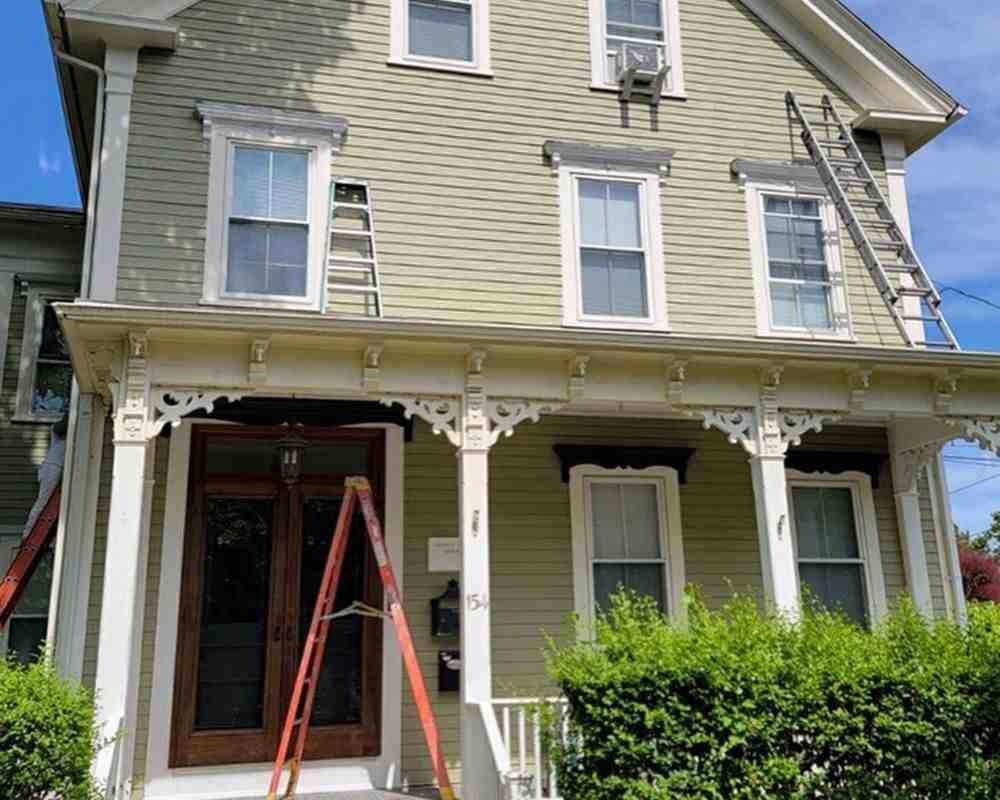
Why Historic Home Exterior Colors Matter More Than You Think
Historic home exterior colors are more than just a decorative choice—they’re a crucial part of your home’s architectural integrity and story. Here’s what you need to know:
- Era matters: Colonial homes (1640s-1780s) typically used two-color schemes with earthy tones, while Victorian homes (1860-1915) acceptd three to five colors
- Three key elements: Most historic homes use distinct colors for the body (main walls), trim (decorative woodwork), and sash (doors and windows)
- Dark is traditional: Window sashes and shutters were usually painted black or dark green in the 19th century, not white
- Natural pigments ruled: Before the Industrial Revolution, paint colors came from earth pigments like red oxide, yellow ocher, and lamp black
- Mass production changed everything: After the 1850s, synthetic dyes expanded color options dramatically
Despite its Puritan underpinnings, New England’s first years were not colorless. The homes that line Rhode Island’s historic streets tell stories through their carefully chosen hues—from the muted earth tones of Colonial clapboards to the rich, jewel-like palettes of Victorian Queen Annes. But choosing the right colors isn’t just about picking what looks pretty. It’s about understanding the technology, materials, and aesthetic philosophy of the era your home represents.
Many homeowners struggle with this. Paint everything white and you obscure the architectural details that make your home special. Choose garish “Painted Lady” colors and you risk creating a cartoon version of history. The key is understanding why certain colors were used, how they were applied, and where each color belongs on your home’s facade.
I’m Michael Catanzaro, and for over three decades, Catanzaro & Sons has specialized in historic home restorations throughout Rhode Island, helping homeowners steer the complex world of historic home exterior colors with expertise passed down through generations. Whether your home dates to the Colonial period or the Craftsman era, we’ve helped preserve its authentic character while protecting your investment.
The “Why” Behind the Hue: Understanding Historical Paint Technology
Before we dive into specific palettes, understand the science behind historic home exterior colors. The availability of pigments and the technology to create paint profoundly shaped what colors graced our homes. Think of it like this: your home’s original paint job was a direct reflection of the materials and knowledge of its time.
Until the Industrial Revolution, which truly took hold in the mid-19th century, paint was a much simpler affair. Most paints were mixed in small batches right on-site, using pigments found directly in nature. This meant a limited, yet beautiful, palette derived primarily from earth minerals. Common pigments included:
- Red oxide: Providing rich reds and browns.
- Yellow ocher: Creating warm yellows and golden hues.
- Lamp black: For deep blacks and grays.
- Red and white lead: Essential for many colors, including whites and reds.
These natural pigments were typically mixed with a binder like linseed oil, which gave early oil paints a distinctive yellowish tint, even for pale colors. This is why the “white” of the 18th and early 19th centuries wasn’t the bright, stark white we know today, which relies on modern titanium dioxide pigments (commercially available since the 1920s). To learn more about these early paint compositions, you can explore resources like this guide on early paint pigments.
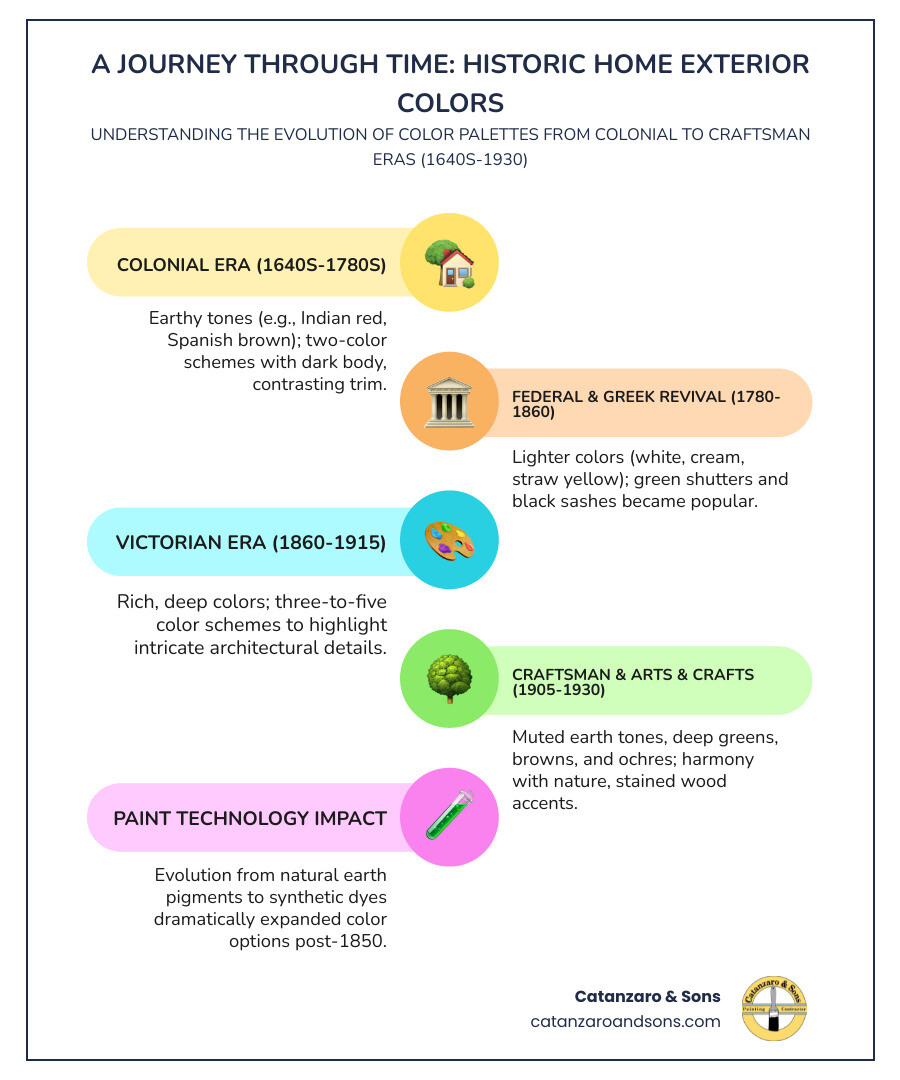
The Industrial Revolution marked a significant turning point. The second half of the 19th century saw the advent of mass-produced paints and, crucially, the introduction of synthetic dyes. This expansion of pigment availability meant a dramatically expanded color range and more saturated colors than ever before. Suddenly, homeowners had a much broader spectrum to choose from, though earth tones like ochres, various shades of green, browns, and deep reds still remained popular. This technological leap allowed for the more complex and vibrant color schemes that would become characteristic of later architectural styles, especially the Victorians.
A Journey Through Time: Popular Historic Home Exterior Colors by Era
The story of American architecture is a vibrant mix, and the evolution of historic home exterior colors weaves through every thread. From simple, functional choices to elaborate, multi-hued schemes, each period offers a unique aesthetic. Let’s take a stroll through time and explore the palettes that defined some of America’s most beloved architectural styles, many of which you can still find adorning homes here in Rhode Island:
- Colonial & First Period (c. 1640s-1780s)
- Federal & Greek Revival (c. 1780-1860)
- Victorian Era (c. 1860-1915)
- Craftsman & Arts and Crafts (c. 1905-1930)
Colonial & First Period (1640s-1780s)
Our earliest Rhode Island homes, particularly those from the First Period (1640s-1720s), were often modest and, quite frankly, unpainted. Paint was expensive, and practicality often won out over aesthetics. If painted, the colors were simple, derived from the natural earth pigments we discussed earlier. Bodies were often unpainted or painted a dark chocolate brown, mimicking weathered clapboards. Trim might be unpainted or painted in contrasting shades of Indian red or Spanish brown.
As we moved into the Georgian period (1725-1780), paint became more common, and color schemes grew stronger and more contrasted. Georgian houses often featured colors that imitated stone construction, such as pale grays or yellowish-whites. Bodies might be painted in dark stone colors, chocolates, oranges, ochres, grays, or reds. Trim was almost always a “white” with a softer, yellower tint than modern whites, and doors often sported dark colors like chocolate, red, green, or blue. The Ipswich Historical Commission notes that First Period houses generally used only two colors, while later styles often had three. This shift reflects a growing sophistication in both architectural design and paint application. For more insights into early New England colors, you can refer to resources like this guide from the Ipswich Historical Commission.
Federal & Greek Revival (1780-1860)
Following American independence, a new sense of style emerged, moving away from the more robust Georgian aesthetic. The Federal Period (1780-1830) saw a trend towards lighter, more refined historic home exterior colors. White and cream became increasingly popular for house bodies, along with pale shades of stony gray and ochre. These “whites” still carried a yellowish tint due to the linseed oil binder. While house fronts might be painted in these fashionable, lighter hues, the back and sides were sometimes painted in more traditional, cheaper reds. Trim was usually white or the same color as the body, while doors and shutters were typically dark green or black.
The Greek Revival period (1825-1860), which flourished across Rhode Island, acceptd a similarly restrained palette, often drawing from the earth-based pigments of the Federal era. In fact, a classic color scheme for Greek Revival homes became almost standard: a white or off-white body, green doors and shutters, and black sashes. This combination created a crisp, neat look that perfectly complemented the architectural lines. For more details on Federal period colors, you can check out this resource. If your home in Barrington, Rhode Island, is a Federal or Greek Revival style, understanding these palettes is key to an authentic restoration. Our team at Catanzaro & Sons can help you select the perfect scheme, as we often do for Residential Painting Barrington projects.
Victorian Era (1860-1915)
The Victorian Era brought an explosion of color, thanks in large part to the new synthetic dyes and mass-produced paints. This was a time of bold expression, where homes often sported three, four, or even five historic home exterior colors to highlight their intricate architectural details.

A vibrant Victorian home showcasing a multi-color scheme, a common sight in historic neighborhoods like those in East Providence, RI.
While earth tones like ochres, greens, browns, and deep reds remained popular, the range expanded dramatically. Later Victorian homes (1870-1900), particularly the elaborate Queen Anne style (1880-1915), acceptd rich tertiary colors. Color theory, based on the color wheel, began to influence choices, leading to schemes that were either “harmony by analogy” (adjacent colors) or “harmony by contrast” (opposite colors).
- Early Victorian (1840-1870): Still saw traditional stone and earth colors, often with trim in a darker shade of the body color.
- Later Victorian (1870-1900): Featured new pastels (rose, peach, terracotta, olive) alongside deeper, saturated hues. Three-color schemes were common, with a fourth or fifth color often used on some houses.
- Queen Anne (1880-1915): Often used four- and occasionally five-color schemes, with body, trim, and sash always in different colors. Rich tertiary colors were favored.
- Stick Style (1860-1890): Used vibrant, contrasting colors to define geometric patterns, with flat trim boards clearly distinguished from clapboard sheathing. Sash and doors were dark but colorful: dark brown, deep red, maroon, dark green, or black.
This was a dramatic shift from the simpler palettes of earlier periods. For more on the fascinating history of Victorian colors, you can dig into New England Historic Paint Colors. Our team at Catanzaro & Sons has extensive experience with these complex palettes, making us trusted Heritage Home Painters for homes across Rhode Island.
Craftsman & Arts and Crafts (c. 1905-1930)
As the Victorian era faded, the Arts and Crafts movement emerged, emphasizing harmony with nature, handcrafted quality, and honest materials. This translated into historic home exterior colors that were generally more subdued and earthy, designed to blend with the landscape rather than stand out.
Muted earth tones were paramount. Stained wood, particularly for shingles and trim, was very common, allowing the natural beauty of the material to shine through. Paint colors typically included deep greens, browns, ochres, and other naturalistic shades. Softer, restrained shades were preferred for bungalows, creating a sense of warmth and understated elegance. Colors like Alden Till or Richardson Brick for siding, complemented by Saxon Blue or Seal Blue for trim and sash, were common choices. This style often involved a thoughtful interplay between painted and natural wood surfaces, requiring skilled Expert Carpentry Services in Rhode Island to prepare and restore these elements before painting.
The Art of Placement: Applying Colors for Authentic Appeal
Choosing the right historic home exterior colors isn’t just about selecting a beautiful palette; it’s also about knowing where each color belongs. Historically, paint was used to delineate a home’s architectural elements, creating visual depth and highlighting craftsmanship.
The Ipswich Historical Commission notes that early First Period houses were typically two-color schemes, but later styles often featured three. Indeed, for most 19th and early 20th-century homes, a three-color scheme became the standard:
- Body Color: This is the main color applied to the primary sheathing material, such as clapboard or shingles.
- Trim Color: This color is used on all decorative woodwork that frames the large wall surfaces and smaller elements. This includes cornices, window and door casings, cornerboards, and molded details. A good rule of thumb: if it’s woodwork and not the main siding, it’s trim. Trim pieces should always connect and link up, forming a cohesive frame.
- Sash Color: This color is reserved specifically for the movable parts of the windows (the sashes) and doors.

Accent colors, a fourth or fifth color, came into play during the Victorian era, used strategically to highlight unique architectural features like sunbursts in pediments or astragal moldings. However, restraint is key. Accents should be applied consistently to unique details, not randomly splashed onto utilitarian elements like gutters or band moldings, which can create a “magic marker” effect.
A crucial point, often misunderstood today, is the color of sashes and doors. For most of the 19th century, these elements were painted in deep, dark colors—black and dark green being the two most common. These dark hues visually recede, drawing the eye into the building and reinforcing a perception of depth. Painting sashes white, a more modern trend, tends to flatten the facade and detract from a historic home’s authentic look.
Bringing History Home: Your Practical Guide to Color Selection
Now that we’ve journeyed through the ages, you might be thinking, “How do I apply all this to my historic home in Rhode Island?” It’s a fantastic question, and one we help homeowners with every day. The goal is to choose historic home exterior colors that honor your home’s unique past while also looking stunning today.
How to Choose the Right Historic Home Exterior Colors
The best approach combines careful research with expert guidance:
- Paint Analysis: The gold standard for identifying original colors is a professional paint analysis. Tiny paint chips are taken from various layers of your home’s exterior and analyzed under a microscope to reveal the oldest colors. This process can uncover not only the original palette but also subsequent color changes.
- Historic Color Consultants: If a full paint analysis isn’t feasible, or you need help interpreting the results, a historic color specialist can be invaluable. Many consultants can even work remotely, guiding you based on photos and your home’s architectural style.
- Local Historical Commissions: For homes in designated historic districts in places like Bristol, East Providence, or the East Side of Providence, your local historical commission may have guidelines or recommended palettes. They are a fantastic resource for ensuring your choices are appropriate. The Cambridge Historical Commission, for example, offers a useful guide to historically appropriate colors that provides general principles applicable across New England.
- Manufacturer Collections: Many reputable paint companies have curated historical collections.
- Benjamin Moore Historic Color Collection: This collection contains 191 colors, numbered HC-1 to HC-191, inspired by America’s rich architectural tradition.
- Sherwin Williams Historic Collection: Offers exterior historic palettes designed to pay homage to key architectural styles throughout American history.
- Historic New England’s Historic Colors of America: This collection, developed in partnership with California Paints, features 149 authentic shades used from the 1600s to 1895. It’s a particularly relevant resource for homes here in Rhode Island and the broader New England region. You can explore the Historic Colors of America collection for period-appropriate options.
- Books and Publications: Excellent books, such as Roger Moss’s work on historic colors (mentioned in this Amazon listing), provide detailed insights into historical palettes.
Common Mistakes to Avoid
When selecting historic home exterior colors, it’s easy to fall into common traps that can detract from your home’s authenticity and appeal. We’ve seen it all, and we’re here to help you steer clear:
- The “All-White” Trap: While white became popular for Greek Revival bodies around 1820, painting a historically multi-colored house entirely white is a major misstep. It obscures the architectural details that were designed to be highlighted by contrasting colors. The “white” of history was also usually an off-white, not today’s stark, bright whites.
- The “Painted Lady” Misinterpretation: The phrase “Painted Lady” often conjures images of vibrant, multi-colored Victorian homes. However, the use of garish, overly bright colors (especially purples, pinks, and aquas) is often a modern misinterpretation of late 19th-century color use. While Victorians used many colors, they were typically rich, deep, and earthy, not neon. Here in New England, such bright schemes can look particularly out of place.
- Ignoring Architectural Style: Choosing colors that don’t align with your home’s architectural period is like putting a modern hat on a historical costume. A Colonial home shouldn’t be painted in a Victorian palette, and vice versa. Each era has its own distinct character that color should improve.
- Forgetting Trim and Sash Rules: As we discussed, the placement of colors on body, trim, and sash is critical. Painting window sashes white, for instance, goes against centuries of tradition and can flatten the look of your home. Dark sashes (black or dark green) were the norm for most of the 19th century and create a much more authentic and appealing visual.
- Random Accenting: Randomly highlighting architectural details with bright or contrasting colors creates visual confusion rather than elegance. Accent colors should be applied consistently to unique, significant features, not to every little detail.
Avoid the common mistake of painting a historic home a single, stark color. A thoughtful, multi-color palette (right) highlights architectural details and honors its heritage.
Understanding these pitfalls is a crucial step towards making informed choices for your home. For more detailed insights into exterior color choices, check out our Exterior Paint Ideas Guide.
Finding Your Palette: Trusted Resources
Navigating the vast world of historic home exterior colors can feel overwhelming, but thankfully, many excellent resources are available:
- Paint Manufacturer Collections: As mentioned earlier, Benjamin Moore and Sherwin-Williams offer dedicated historical collections.
- The Benjamin Moore Historic Color Collection provides 191 time-honored colors inspired by American history and architectural tradition.
- The Sherwin Williams Historic Collection features curated palettes that pay homage to key architectural styles.
- Historic New England: This organization is a treasure trove of information for our region. Their Historic Colors of America collection, in partnership with California Paints, offers 149 authentic shades used from the 1600s to 1895.
- Preservation Societies and Local Commissions: Your local historical society or preservation commission in towns like Cranston, Johnston, or East Greenwich can provide invaluable local context and guidance.
- Specialized Books: Books like Roger Moss’s on historic colors (e.g., Paint in America: The Colors of Historic Buildings) are excellent references for in-depth research.
Frequently Asked Questions about historic home exterior colors
We often get asked similar questions about historic home exterior colors from homeowners across Rhode Island. Here are some of the most common, along with our expert answers:
How many colors should I use on my historic home’s exterior?
The number of colors depends heavily on your home’s architectural period.
- Colonial and First Period (17th-18th Century): Often used only two colors, or even one (body color with unpainted trim).
- Federal and Greek Revival (Late 18th-Mid 19th Century): Typically moved to three-color schemes (body, trim, sash/doors).
- Victorian Era (Late 19th-Early 20th Century): This is where color exploded! Later Victorians, especially Queen Annes, could feature three, four, or even five colors to highlight their elaborate details.
For most 19th and early 20th-century homes, a three-color scheme (body, trim, and sash/door) is a safe and historically appropriate starting point. This creates visual depth and interest without being overwhelming. When we undertake projects as a House Painter Contractor Cranston RI, we carefully plan these schemes.
Should my window sashes be white?
Almost certainly not, if you’re aiming for historical accuracy. For most of the 19th century, sashes were painted in deep, dark colors like black or dark green. This created a sense of depth and drew the eye into the building. White sashes are a more modern trend that can make a historic home look flat and detract from its authentic character. We always recommend dark sashes to improve the look of almost any historic home.
Can I use modern paint on my historic house?
Yes, absolutely! While historic paints used different formulations, modern acrylic latex paints offer superior durability, fade resistance, and ease of application. The key is to choose historically accurate colors and sheens. You’ll want to select colors that match the historical pigments and ensure the paint is suitable for the material, especially for Exterior Wood Painting. Modern paints are designed to withstand Rhode Island’s varied weather conditions far better than their historical counterparts, ensuring your beautiful, historically accurate colors last for years to come.
Conclusion: Preserving Your Home’s Legacy with Color
Choosing historic home exterior colors is a journey through time, a blend of art and science, and a profound way to connect with your home’s past. It’s about more than just aesthetics; it’s about preserving the architectural legacy that makes your Rhode Island home truly unique. By understanding the historical context, the evolution of paint technology, and the appropriate application of colors to different architectural elements, you can transform your home with authenticity and pride.
We believe that every historic home has a story to tell, and we’re passionate about helping our neighbors throughout Rhode Island ensure those stories are beautifully preserved. With over 30 years of experience, Catanzaro & Sons stands as Rhode Island’s premier painting contractor, offering not just exceptional painting services but also the trust and honesty that come from a local, family-owned business. We specialize in residential and commercial painting, including historic home restorations, and our 100% dedication to each customer’s complete satisfaction sets us apart.
Your historic home is a piece of Rhode Island’s legacy, and it deserves the care of a team that understands its unique character. Trust your home’s story to the experts at Catanzaro & Sons. If you’re ready to give your historic home the authentic, beautiful refresh it deserves, choosing the right painting contractor is key. Learn more about How to Choose the Right Painting Contractor in Rhode Island for Your Home or Business. We’re here to help you bring your vision to life, honoring your home’s past for generations to come.