Why Your Home’s Exterior Deserves More Than Just a Fresh Coat
Exterior paint ideas can transform your property from overlooked to unforgettable. Whether you’re refreshing a historic Rhode Island colonial or updating a modern family home, the right color palette makes all the difference. Your home’s exterior is the first thing neighbors and guests see, but choosing colors can be overwhelming.
Quick Guide to Exterior Paint Ideas:
- Timeless Neutrals: Whites, grays, and beiges work with any architectural style.
- Bold & Dramatic: Black, charcoal, and navy create modern statements.
- Earthy Tones: Warm clays and rich browns connect with natural landscapes.
- Style-Specific Palettes: Traditional homes favor whites with dark shutters; Craftsman styles shine with olive greens.
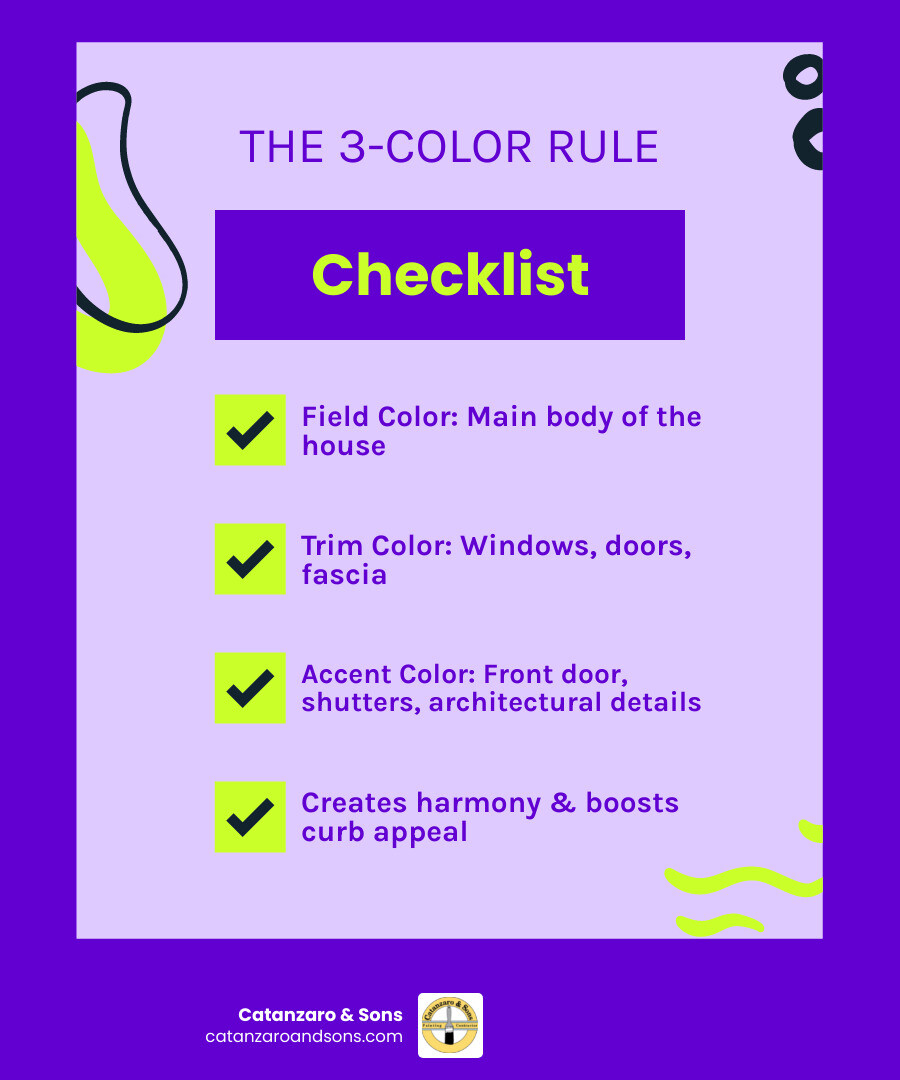
- The 3-Color Rule: Use a main body color, a trim color, and an accent color for doors or shutters.
With hundreds of paint chips and the fear of costly mistakes, it’s a significant decision. At Catanzaro & Sons, we’ve spent over 30 years helping Rhode Island homeowners steer these choices. We’ve painted everything from 18th-century colonials to new builds, so we know what works in New England’s climate and architectural landscape.
This guide breaks down everything you need to know about exterior paint ideas, from matching your home’s style to testing colors like a pro.
Choosing Your Perfect Palette: Key Factors to Consider
Choosing exterior paint colors works best when they complement what’s already there. Your home’s unchangeable features—like the roof, stonework, or brick—provide a built-in starting point for your color palette. Look at your roof first. A warm brown roof pairs well with creamy whites, while a cool gray roof looks stunning with crisp whites and charcoal accents. Working with these fixed elements makes the whole look come together naturally.
Match Your Home’s Architectural DNA
Every home has a story written in its architecture, and the colors should reflect that. A classic colonial in Providence, for instance, suits a timeless white-with-black-shutters combination. It honors the home’s heritage while keeping it fresh. Modern homes, on the other hand, can handle bold choices like dramatic charcoal or deep navy that would overwhelm a historic property. Craftsman and bungalow homes, born from the Arts and Crafts movement, celebrate natural materials and earthy tones like olive greens, warm browns, and deep ochres. The key is to identify your home’s personality—stately, cozy, or contemporary—to find colors that bring out its best character.
Consider Your Home’s Environment
Your home’s surroundings have a huge impact on how colors appear. A home surrounded by trees will have dappled shade that can make colors look muddy, while a house in an open lot gets constant sun that can wash colors out. You also want colors that feel cohesive with your neighborhood without being identical to your neighbor’s house. If you’re in an HOA community, be sure to check their guidelines before choosing.
Most importantly, lighting affects paint color dramatically. That perfect gray from the paint store can look completely different on your house. How lighting affects paint color is critical to understand. A north-facing wall gets cool, indirect light, making colors appear darker. A south-facing wall gets intense sun, making them look brighter. This is why testing is essential.
The Secret to Sampling Colors Like a Pro
The biggest mistake is choosing a color from a tiny paint chip in the store. A 1-inch square tells you almost nothing about how it will look across an entire house.
Here’s how to test colors properly:
- Start with large samples. Use peel-and-stick samples or buy small sample cans of your top two or three choices.
- Paint large swatches. Create swatches at least 2 feet by 2 feet on foam board or an inconspicuous part of your siding.
- Observe at different times. Check the swatches in the morning, at midday, and in the late afternoon. See how they look on a sunny day versus a cloudy one.
- Test on multiple walls. A color may look perfect on the sunny front of your house but wrong on the shaded north side. Move your samples around to see how orientation affects the color.
This process saves heartache and money every time. Homeowners who sample properly are always the happiest with the final result.
Timeless and Trending Exterior Paint Ideas

After three decades of painting Rhode Island homes, we’ve seen trends come and go, but some palettes never lose their appeal. Here are some of our favorite color families that consistently deliver high curb appeal.
Timeless Neutrals: Whites, Grays, and Beiges
Neutrals are popular because they simply work. These sophisticated shades complement any architectural style and create a welcoming canvas for your landscaping and architectural details.
- Classic Whites: A crisp, clean look that brightens any home. Popular choices include Sherwin-Williams Pure White SW7005 and Benjamin Moore White Dove OC-17.
- Warm Off-Whites: For a softer, more inviting feel, try creamy shades like Sherwin-Williams Greek Villa SW7551 or Valspar Swiss Coffee.
- Greige & Taupe: The perfect blend of gray and beige, greige is famously versatile. Benjamin Moore Revere Pewter HC-172 is a legendary choice that works in almost any light. Warm taupes also offer a balanced, sophisticated backdrop.
Moody & Modern: The Power of Dark Exteriors
Dark exteriors have moved from a trend to a mainstay, creating drama, sophistication, and a modern edge.
- Black & Charcoal: For the ultimate contemporary look, consider Benjamin Moore Black HC-190 or Sherwin-Williams Tricorn Black SW6258. If true black is too intense, deep charcoals like Benjamin Moore Charcoal Slate HC-178 provide similar drama with more softness.
- Rich Navy Blue: A timeless choice with coastal charm, perfect for Rhode Island. Hale Navy HC-154 by Benjamin Moore is a perennial favorite that gives even traditional homes a fresh feel.
- Forest Green: Deep greens like Benjamin Moore Black Forest Green create an earthy, grounded aesthetic that feels both bold and natural, pairing wonderfully with cream trim.
Earthy Tones that Connect with Nature
Colors that feel drawn from the landscape create harmony between your home and its surroundings.
- Earthy Greens: Olive and sage tones like Sherwin-Williams Renwick Olive SW2815 blend seamlessly with lush landscapes for a serene, organic look.
- Terracotta & Clay: For a warmer, sun-baked aesthetic, shades like Sherwin-Williams Cavern Clay SW7701 bring rustic charm and stand out without shouting.
- Rich Browns: Colors like Sherwin-Williams Homestead Brown SW7515 evoke stability and warmth, working especially well on homes with stone foundations or natural wood accents.
Color Palettes for Popular Home Styles

The best exterior paint ideas honor your home’s architectural personality. Choosing colors that make your home the best version of itself is key, whether it’s a historic colonial in Bristol or a contemporary build in Warwick.
Traditional & Colonial Homes
These stately homes, common from Barrington to East Greenwich, deserve colors that reflect their timeless elegance.
- Classic White & Black: The combination of a white body (like Benjamin Moore Olympic Mountains 971) with black shutters (Benjamin Moore Black HC-190) is crisp, clean, and never goes out of style. A red door adds a perfect pop of color.
- Softer Palettes: For a warmer look, try a creamy white body with forest green shutters (like Benjamin Moore Lafayette Green HC-135).
- Gray & White: A versatile trio of a white main color, a gray accent (like Sherwin-Williams Colonnade Gray SW7641), and black for doors creates a sophisticated palette that feels both classic and current.
Modern & Contemporary Homes
Modern homes thrive on bold choices and clean lines. Their simple forms are improved by intentional color.
- Monochromatic Schemes: Using varying shades of one color, such as a medium gray for walls and a lighter gray for accents, creates a sleek look that lets the architecture speak for itself.
- Bold Accents: A neutral foundation, like Behr’s Ultra Pure White, provides the perfect backdrop for a dramatic front door in a color like deep blue or even black.
- Natural Wood Tones: If your home features wood elements, pair them with a deep gray or black paint (like Sherwin-Williams Tricorn Black SW6258) to create beautiful textural contrast.
Craftsman & Bungalow Homes
These homes celebrate natural materials and handcrafted details. The right colors will make every detail shine.
- Nature-Inspired Palettes: Earthy tones are the soul of Craftsman style. Think an olive green body (like Sherwin-Williams Renwick Olive SW2815) with brown trim and a muted red door.
- Ochre Accents: Warm golden-yellows like Sherwin-Williams Independent Gold SW6401 are perfect for highlighting architectural details like brackets and columns against a darker body color.
Coastal & Beach Houses
For homes in Narragansett, South Kingstown, and along the shore, colors should celebrate the connection to the ocean.
- Light & Airy Blues: Shades like Sherwin-Williams Drizzle SW6479 or Benjamin Moore Harbor Haze 2136-60 create a calm, breezy atmosphere, especially when paired with crisp white trim.
- Sandy Whites & Beiges: Warm whites like Sherwin-Williams Oyster White SW7637 evoke the feeling of sunshine on sand, staying fresh in summer and cozy in winter.
- Seafoam Green: Refreshing greens like Sherwin-Williams Privilege Green SW6193 bring an ocean spray feeling that is both sophisticated and relaxed.
Ready to see how these colors can transform your home? Explore our residential painting services to find how we bring your vision to life.
Pro Tips for a Flawless Finish
Choosing the right colors is just the beginning. To achieve a flawless finish that boosts curb appeal and longevity, focus on the details that make all the difference.
Using Accent Colors for Maximum Curb Appeal
Accent colors add personality and depth. Most exterior schemes use a main body color, a trim color, and one or two accent colors for specific features.
- Front Doors: A brightly colored front door in red, blue, or green instantly boosts curb appeal and signals where to enter.
- Shutters: Shutters offer great contrast. Many homeowners match them to the front door or choose a shade lighter or darker than the body color for a subtle effect.
- Window Trim: Crisp white trim, like Sherwin-Williams Extra White SW7006, makes windows pop and defines your home’s architectural lines.
- Architectural Details: Use a contrasting color to highlight unique features like gables, corbels, or decorative moldings.
- Porch Ceilings: A traditional touch is to paint a porch ceiling a light “haint blue,” which brightens the space and adds a refreshing feel.
Smart Exterior Paint Ideas for Small Homes
For smaller homes, the right colors can make the house appear larger and more inviting.
- Light, Airy Colors: Light colors like whites, off-whites, and pale grays make a small house look larger. Benjamin Moore’s Swiss Coffee OC-45 is an excellent choice.
- Monochromatic Schemes: Using a single color, or subtle variations of it, on the body and trim creates a seamless look that feels more expansive.
- Avoid High Contrast: Too much contrast can make a small home look chopped up. Opt for subtle contrasts between the body, trim, and accents.
Choosing the Right Paint Sheen and Type
The sheen and type of paint are as important as the color, affecting durability and appearance.
- Paint Sheen Guide:
- Flat/Matte: Best for siding, as it hides imperfections.
- Satin/Low Lustre: A popular, durable choice for siding, trim, and doors. It has a slight sheen and is easy to clean.
- Semi-Gloss: Ideal for trim, shutters, and doors, as it highlights details and is very durable.
- Gloss/High-Gloss: Use on front doors for a reflective, durable finish that really stands out.
- High-Quality Paint Benefits: Always use high-quality exterior paint with UV resistance. Products like Benjamin Moore’s Aura® Exterior and Element Guard® offer superior durability and color retention against harsh New England weather. For older homes, a high-build formula like Regal® Select can bridge small cracks.
- Painting Vinyl and Stucco: Yes, you can paint both! For vinyl siding, use paints from a vinyl-safe color palette to prevent warping. For stucco, use a paint designed for masonry that offers breathability and moisture resistance.
Frequently Asked Questions about Exterior Painting
Here are answers to the questions we hear most often from Rhode Island homeowners.
How many exterior paint colors should I use?
The 3-color rule is a formula that almost always works. It creates a cohesive and intentional look.
- Body Color: The main color that covers the largest area of your siding.
- Trim Color: A contrasting or complementary shade for window frames, door frames, and fascia.
- Accent Color: A pop of color for the front door, shutters, or other small architectural details.
A fourth color can sometimes be used to highlight a unique feature, but three is usually the perfect number to tell a complete story.
What is the most popular exterior house color?
Whites and off-whites are timelessly popular, offering a clean, fresh look that works with any architectural style. Colors like Benjamin Moore’s White Dove OC-17 remain a top choice.
However, grays and dark colors are increasingly popular. Sophisticated grays, dramatic charcoals, deep navy blues, and even black have become mainstream choices, especially for modern homes or historic properties seeking a contemporary update. In the Northeast, these schemes look stunning against our changing seasons.
How often should I repaint my home’s exterior?
As a general rule, you should plan to repaint your home’s exterior every 5 to 10 years. The exact timing depends on several factors.
- Climate: New England’s humid summers, freezing winters, and coastal salt air are tough on paint. Homes with high sun exposure or proximity to the ocean may need repainting closer to the 5-year mark.
- Paint Quality: High-quality paints like Benjamin Moore’s Aura® Exterior last significantly longer than cheaper alternatives. Investing in quality paint saves money in the long run.
- Surface Material: Wood siding typically requires more frequent painting than vinyl or stucco.
Watch for warning signs like fading, chalking, cracking, or peeling. These indicate that your home’s protective barrier is compromised and it’s time to repaint.
Conclusion: Bring Your Vision to Life with a Trusted Partner
We hope this guide has made you feel more confident about choosing exterior paint ideas for your home. By understanding your home’s architecture, testing colors properly, and selecting the right palette, you can transform your exterior into something truly special.
Your home’s exterior is an investment in its value and curb appeal. At Catanzaro & Sons, painting homes throughout Rhode Island is our passion. For over 30 years, our local, family-owned company has been the trusted painting contractor for homeowners who want the job done right. We understand New England homes, from the challenges of our coastal climate to the character of historic properties in Providence and Bristol.
Our expertise includes residential and commercial painting, with a special pride in historic home restoration. We combine our 100% work guarantee with continuing education in the latest techniques and products to deliver lasting results. We treat every project with the care we’d give our own homes.
Ready to bring your exterior paint ideas to life with expert craftsmanship and honest advice?
Contact us for a free estimate on your painting project. Let’s make your home the one everyone notices—for all the right reasons.